

Inkrypt.ai delivers application-level encryption through lightweight SDKs that integrate directly into modern applications. Unlike perimeter-only or infrastructure-focused encryption solutions, Inkrypt encrypts sensitive data elements at the moment they are created or processed by the application—before the data is stored, logged, transmitted, or shared with downstream services.
Inkrypt operates alongside existing enterprise security controls rather than replacing them. Transport-level security (TLS / mTLS), disk and volume encryption, HSMs, and cloud provider security remain intact and continue to serve their intended roles. Inkrypt focuses on protecting the data itself, regardless of where it travels or resides.
By encrypting data at the application layer, Inkrypt significantly reduces the blast radius of breaches, limits insider threats, and ensures that sensitive data remains protected even in compromised environments.
Core principle:
Inkrypt encrypts data — not pipes, disks, or networks.
Inkrypt follows a shared responsibility encryption model, clearly defining what Inkrypt secures and what remains under standard infrastructure or platform security controls.
| Layer | Encrypted by Inkrypt SDK | Notes |
|---|---|---|
| Authentication secrets | Yes | Tokens, refresh tokens, secrets |
| Business data | Yes | Fields, payloads, documents |
| Database fields | Yes | App-level field encryption |
| Files / object storage | Yes | Encrypted before write |
| API payload fields | Yes | Selective field encryption |
| Data in transit | No | TLS / mTLS |
| Disk / volume encryption | No | OS / cloud |
| Network traffic | No | TLS / IPsec |
Inkrypt intentionally avoids duplicating controls that are already well-addressed by established standards. This ensures clean architecture, minimal overhead, and maximum interoperability.
Authentication systems are a prime target for attackers. Inkrypt strengthens identity protection by encrypting authentication artifacts at rest, without interfering with authentication flows or standards.
Inkrypt SDKs can encrypt:
OAuth 2.0 access tokens and refresh tokens (at rest)
OIDC ID tokens and session metadata
API keys and service-to-service credentials
Sensitive authentication metadata stored by the application
This ensures that even if a database or backup is compromised, authentication secrets remain unreadable.
Inkrypt does not replace:
Authentication protocols (OAuth 2.0, OIDC, SAML)
Identity providers (IdPs)
Password hashing mechanisms (bcrypt, argon2, scrypt)
These controls remain the responsibility of authentication systems and identity platforms.
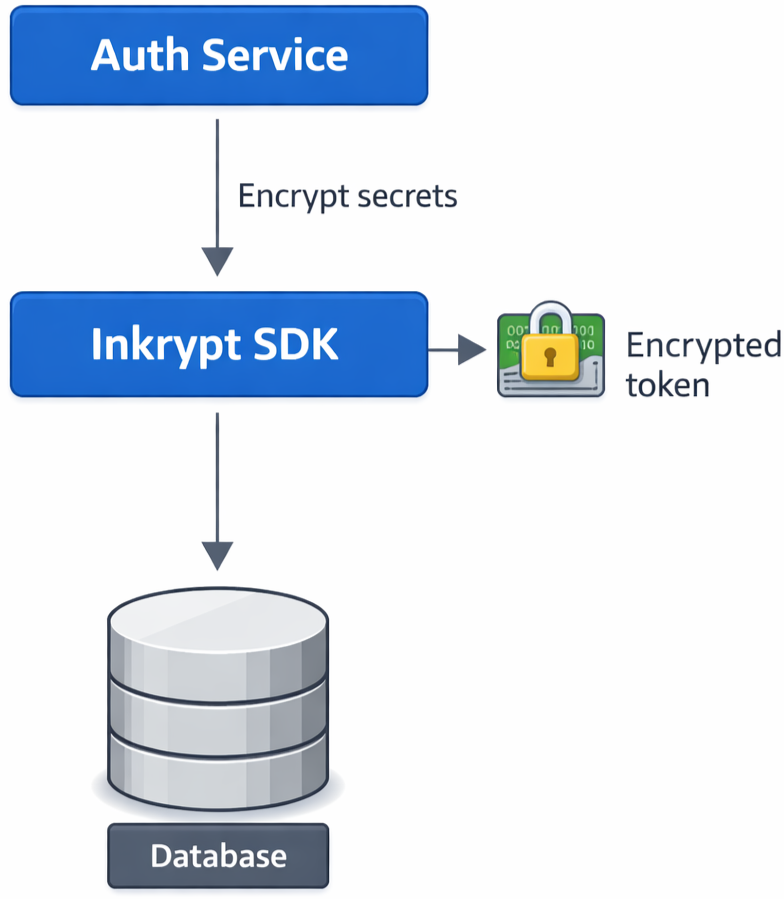
Result: Identity data remains protected without modifying authentication logic or flows.
Inkrypt provides fine-grained, field-level encryption at the application layer, ensuring that sensitive data is encrypted before it ever reaches the database.
Each sensitive value is encrypted using a Data Encryption Key (DEK), which is securely wrapped and managed through Inkrypt’s centralized cryptographic backend.
Database administrators cannot read sensitive data
Stolen backups remain unusable
Cloud providers never see plaintext
Insider threats are significantly reduced
Regulatory compliance is simplified (PCI-DSS, HIPAA, GDPR)
Inkrypt enables zero-trust data storage, where access to infrastructure does not imply access to data.
Modern systems rely heavily on APIs and microservices. Inkrypt enables selective encryption of sensitive API fields, supporting zero-trust architectures.
Encrypting PII, PCI, or PHI fields in API requests
Protecting data across internal microservices
Securing third-party integrations
Reducing trust assumptions between services
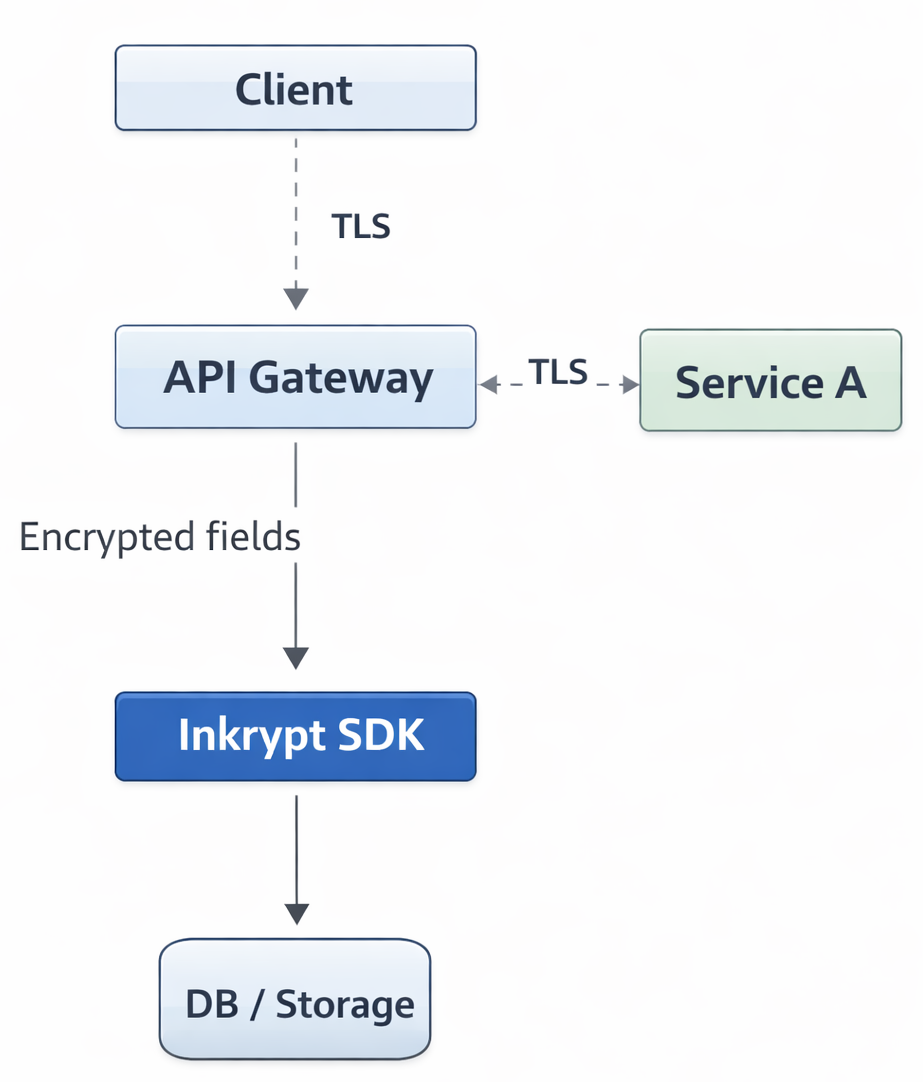
Even if TLS is terminated at gateways or proxies, sensitive fields remain encrypted end-to-end.
Inkrypt is intentionally scoped to application-level encryption. It does not:
Replace HTTPS, TLS, or mTLS
Encrypt disks, volumes, or block storage
Secure operating system memory
Protect against application logic flaws or vulnerabilities
Replace secure coding practices
This clear separation ensures that Inkrypt integrates cleanly into existing security stacks without overlap or confusion.
Inkrypt’s approach aligns with enterprise security principles:
Defense in depth
Least privilege
Zero-trust data access
Separation of concerns
By encrypting data at its source, Inkrypt ensures that security travels with the data, regardless of infrastructure, network, or storage environment.
Inkrypt.ai fills a critical gap in modern security architectures by providing true data-centric encryption. It complements, rather than competes with, network, infrastructure, and platform security.
Organizations that adopt Inkrypt gain:
Stronger data confidentiality
Reduced breach impact
Improved compliance posture
Future-ready encryption architecture
Inkrypt protects what matters most: the data itself.
WhatsApp us